
SEED Student Stories | Four Students from St. Paul's Secondary School Start from Scratch, Discovering Their Users and Themselves Through Design Thinking
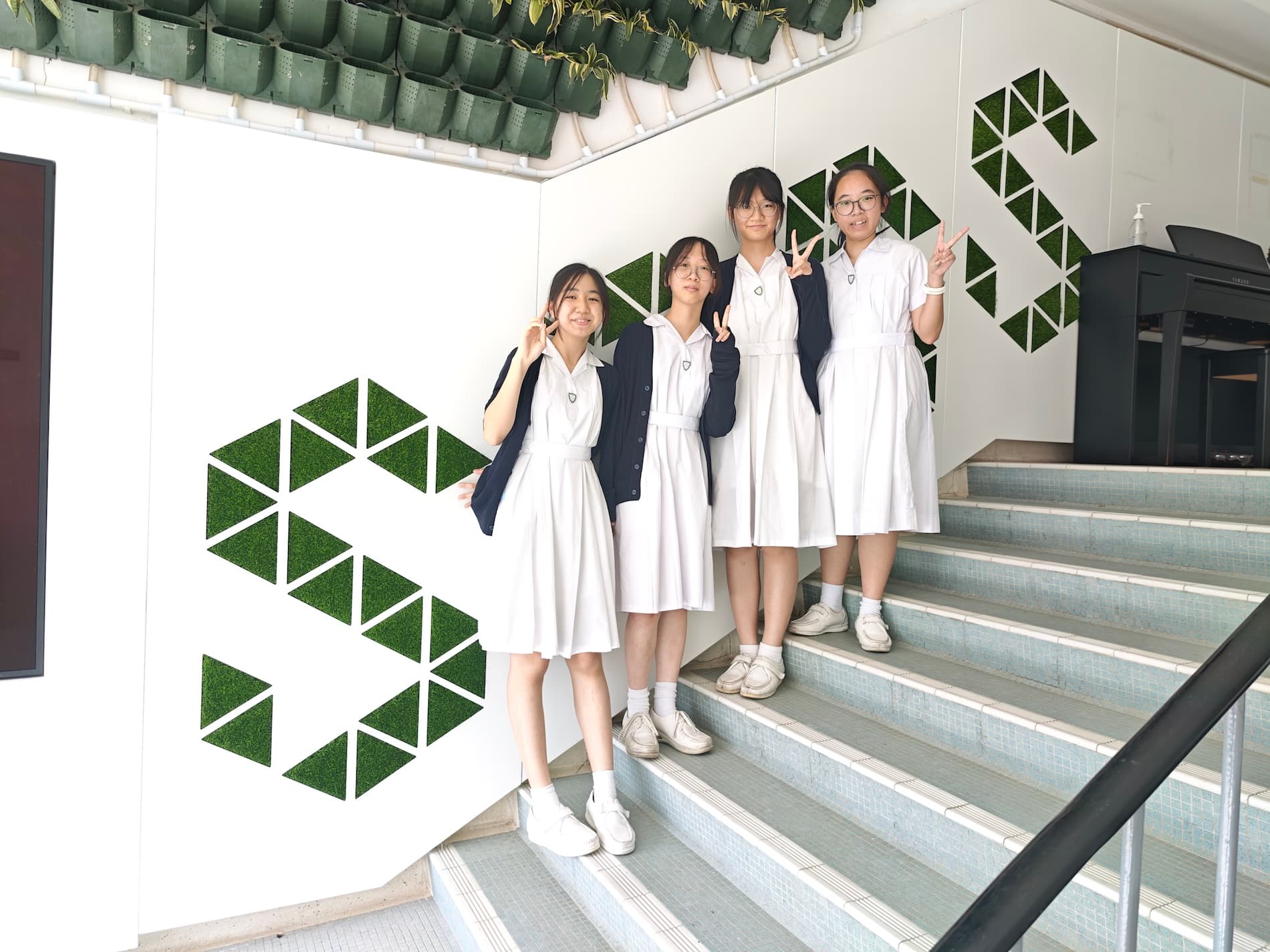
Four students from St. Paul's Secondary School, Andrea, Joanna, Michelle, and Sophie, likely shared the same understanding of "design" as most people before joining SEED's UX/UI course: that it was mainly about colours, layouts, and visual effects. By the end of the course, however, their understanding of design had completely transformed. From learning to empathise with users, mapping out user flows, and building prototypes, to completing a full website design centred on an eco-friendly tree-planting theme, they did not simply acquire a new technical skill. They also grew in communication, aesthetics, and design thinking in ways that went far beyond any textbook. Below are their personal reflections shared after completing the course.

SEED UX/UI Design Course students Andrea, Joanna, Michelle and Sophie (St. Paul's Secondary School), class project: Evergreen.
From "Looking Good Is Enough" to "What Does the User Need?"
Many students encountering UX/UI for the first time tend to equate design with visual presentation. This was precisely Andrea's understanding before the course: she saw UX as simply a stack of features, and UI as making the screen eye-catching enough. This view is not uncommon, yet it is exactly the first mental framework that SEED's course aims to break.
By the end of the course, Andrea's perspective had undergone a fundamental shift. She came to understand that truly effective website design must begin with a deep understanding of user needs, and that through tools such as Empathy Maps and Flow Charts, a prototype that genuinely addresses real-world needs can be gradually built, which was far more complex than she had initially imagined. Sophie further noted that this human-centred design thinking is not limited to the technology industry. Understanding the needs of the people you serve is a core competency that crosses industries, and applies equally to fields as different as social work.
In SEED's view, this is precisely what makes UX/UI education so valuable: it trains not just technical skills, but a way of thinking, one that encourages people to "understand first, then design," and to slow down and truly listen to users before getting started.
Getting Closer to Users: From Personas to Real Pain Points
During the course, the team designed a website for an eco-friendly tree-planting NGO. They initially created personas around university students and volunteers, but through discussion they gradually discovered that the people who genuinely wanted to participate in tree planting were far more diverse than expected, including working adults, elderly people, and various other groups.
They also uncovered user pain points they had not originally anticipated. Sophie said: "We initially just wanted users to learn about tree planting or environmental knowledge, but we later realised that some people genuinely wanted to take part in tree-planting activities in person." The team therefore adjusted their design direction on the spot, adding an event registration page and a donation section, transforming the website from a simple information platform into a fully functional site that could truly inspire action.
Of course, there were also technical challenges to overcome along the way. Michelle admitted: "I had never done anything related to software design before, and had never used Figma." At the same time, the team had differing opinions on colour choices and layout style. Sophie laughed: "Some people wanted blue, some wanted green." Joanna suggested incorporating memes and original characters, believing that as long as they aligned with the environmental theme, "even if it only attracts one or two people, it still counts as a successful meme."
Through guidance from their instructors, self-directed learning via YouTube tutorials, and repeated experimentation with different styles, they ultimately unified their visual language, achieving a look that was both clean and comfortable, and more in keeping with the eco-friendly theme.
Design Prototype: The Most Important Guiding Light
Reflecting on the "Design Prototype," which was central to the course, Andrea felt it gave the team a clear starting point: "It provided a very direct sense of direction, showing us how to design more effectively." With a prototype in hand, design was no longer a matter of aimlessly feeling one's way forward. Michelle added that once the overall page had a basic framework, with buttons, functions, and images all in their proper places, the final result was not only more visually appealing, but also more intuitive and seamless for users browsing the site.
A prototype is not the finished product, but it is the essential backbone of the entire design process. By first sketching out the overall structure of the website and giving each detail a clear direction, it ensures that the team does not lose its way over the course of the long design journey.
No Right Answer in Design, Background Is No Barrier
SEED's UX/UI course has never set subject prerequisites, and this is one of the core principles behind its curriculum design. Michelle noted: "The key to joining this course is not what subjects you study, but whether you have an interest in it. Even without taking ICT, you can participate, because everything in class is taught from the very basics."
From the outset, one of SEED's primary goals was to help students understand that there is no single right answer in design. Students from different disciplines and different schools each bring their own unique perspectives into the classroom. Those seemingly unrelated backgrounds become the most valuable source of inspiration, as each person's viewpoint collides and blends in discussion, piecing together a more complete and nuanced design.
The Most Memorable Lesson: Reflection and Growth
After completing the course, the students each shared what had left the deepest impression on their learning journey. Andrea felt a growth in her aesthetic judgment: she learned how to present a website as a cohesive whole, and developed a more refined eye for selecting images, colours, and fonts.
Michelle experienced a transformation in communication and self-expression. She admitted that she is naturally introverted and that "the way I speak tends to be quite abstract, making it hard for others to understand what I mean." But she has since learned how to express her design ideas clearly, and to explore new styles without being confined to a single approach.
Sophie's reflection perhaps best captures the depth of this learning experience. "In the past, I never truly designed with 'what the user wants to do' in mind. I would simply do things because they looked nice. But now I think first: what does the user actually want? What difficulties might they encounter while browsing?"
This shift in perspective is precisely the seed that SEED hopes to plant in every student, so that people-centred thinking does not remain merely a classroom concept, but becomes a natural and instinctive habit of mind.
Conclusion
From "looking good is enough" to "responding to real needs," and from having no technical foundation to presenting a heartfelt, fully realised design project, the journey that Andrea, Michelle, Joanna, and Sophie have taken is not merely a learning experience, but a genuine transformation in the way they think.
SEED's UX/UI course is designed specifically for secondary school students, with no prior technology or design background required. Covering everything from empathetic thinking to prototyping, it enables students to develop cross-disciplinary design thinking and problem-solving skills through real project contexts. If you are interested in bringing this kind of learning opportunity to your students, we welcome you to get in touch with us to find out more about the course details and collaboration opportunities.